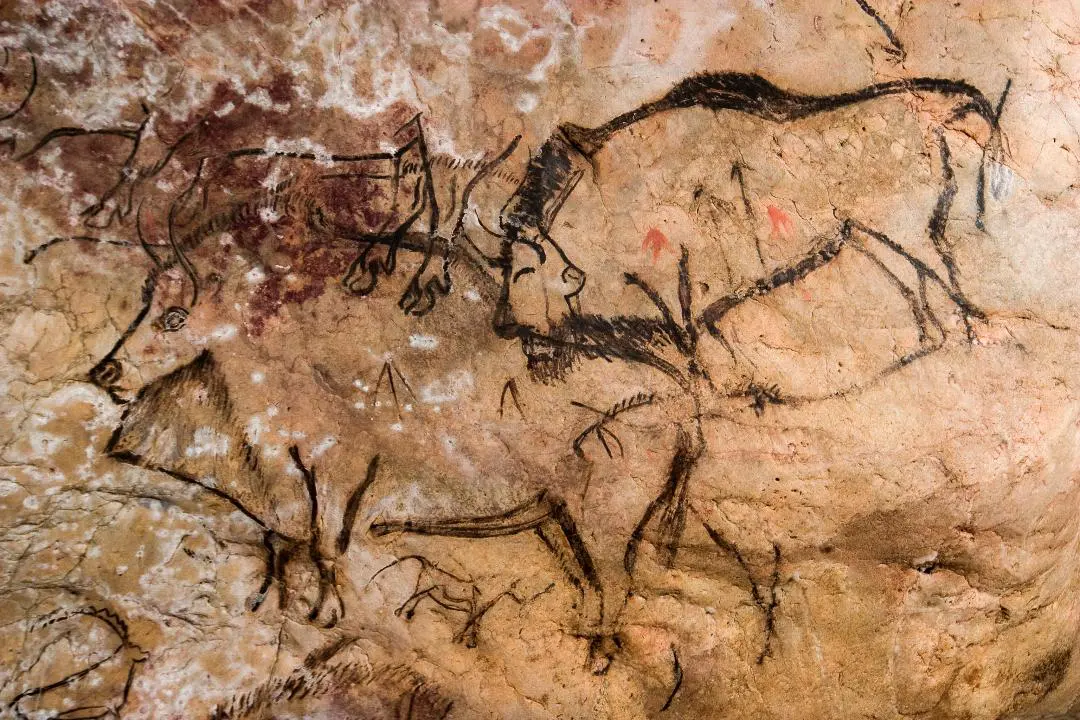
The Ariège Pyrenees are one of the cradles of prehistory, as evidenced by the numerous remains left behind by our ancestors. One need only look at the wealth of decorated caves, archaeological sites, caverns and rock-sheltered sites found throughout the department. Whilst some contain only geological treasures – which are, incidentally, quite remarkable – others reveal numerous traces of settlements, the most iconic of which date from the Magdalenian period, with the highlight being the Niaux Cave and its ‘Salon Noir’.
The Niaux Cave
The Niaux Cave is one of the most famous prehistoric painted caves in Europe. Abbé Henri Breuil, a specialist in prehistoric art, considered it to be one of the "six giants of prehistory". And the prehistorian Leroi-Gourhan said of it that “Niaux is the only cave that rivals Lascaux in terms of the quality of execution and preservation of its works, the scale of the compositions and the spirit that animates them”.
Located opposite the Grotte de la Vache, near Tarascon, it stretches over more than two kilometres of spacious galleries and remains one of the few decorated caves still open to the public. Around a hundred animal depictions and several hundred symbols have been recorded on the walls and floor.
In one of the galleries, graffiti left by visitors can be seen, the oldest dating from 1602. But above all, one can see “the panel of signs”, on which numerous geometric symbols—generally painted in red—are concentrated, the meaning of which remains a mystery. These symbols are also scattered throughout the cave.
Bison, horses, ibex and deer
The highlight remains the “Black Hall”, a vast rotunda with an impressively high vaulted ceiling. This majestic hall contains 85% of the animal depictions. They are grouped into six natural panels, across which 70 animals (bison, horses, ibex and deer) are distributed, with such finesse in the execution of the lines and their arrangement that you cannot help but be moved. One of the defining features of these figures is the depiction of the animals’ anatomical details. Stylistic conventions regarding the animals’ coats, horns or the perspective of their legs are frequently found. These figures are depicted in profile, without a ground line, as if ‘suspended in the air’. A large proportion of these drawings were first sketched in charcoal, then a genuine paint based on manganese dioxide was applied with a brush.
Between 17,000 and 16,000 years before our era
Analysis of the paintings’ composition, and particularly direct samples of charcoal particles, have shown that they were created between 17,000 and 16,000 years before our era. Only part of the cave is open to visitors (by booking), but it is one of the few sites that still offers the profound thrill of following in the footsteps of our ancestors by torchlight. The Clastres network, which extends from it, remains closed to the public to protect these priceless treasures (the famous weasel, a child’s footprints etched into the clay…) but you can see a faithful reproduction of it at the Prehistory Park in Tarascon, as well as a facsimile of the Salon Noir. If you’d like to find out more, you can read the works of the famous Ariège prehistorian Jean Clottes (the man who authenticated the Chauvet Cave when it was discovered). There is no better introduction to the tours than his book “Les Cavernes de Niaux, art préhistorique en Ariège”.
The Mas d’Azil Cave
Listed as a Historic Monument since 1942, the Mas-d’Azil Cave is recognised as an exceptional site due to its impressive geology and archaeological significance. It is the only cave in Europe to be traversed by both a river and a road. It is also the eponymous site of a period: the Azilian.
Mammoths, woolly rhinoceroses, cave bears
Édouard Piette (one of the first French prehistorians of the late 19th century) began excavating the cave in 1887 and discovered short scrapers, flat harpoons made of deer antler, and flat pebbles painted with schematic figures in red ochre. It was he who named the period characterised by these finds the “Azilian” (around 11,500 BCE). Ossuaries still visible on the upper levels have provided valuable information on the fauna of the cold periods and the diet of the Magdalenian people: mammoths, woolly rhinoceroses, cave bears, horses, reindeer, bovids, ibexes… An important prehistoric site, the cave also contains several decorated galleries featuring interesting figures, which are unfortunately inaccessible to visitors. Between 1901 and 1912, Abbé Breuil and Count Bégouën discovered engravings as well as red and black paintings in a small chamber followed by a narrow gallery known as the ‘Galerie Breuil’. Bison, horses, deer, fish, a possible feline and geometric symbols follow one another over a stretch of several dozen metres. Reproductions of the drawings and engravings from these decorated galleries can be seen at the Mas-d’Azil Museum of Prehistory and at the Interpretation Centre.
The Bédeilhac Cave
It is a vast cave featuring impressive stalagmite formations. 14,000 years ago, a Cro-Magnon man left his handprint there.
The Cow’s Cave
Located in Aliat, it is the perfect complement to visits to the caves of Niaux and Bédeilhac; it was home to Cro-Magnon people 13,000 years ago. It has yielded thousands of artefacts to archaeologists: animal bones and teeth, tools and weapons, as well as exquisite decorated objects, each more refined and delicate than the last. Visiting this cave means discovering the private lives and daily routines of our hunter-gatherer ancestors.
C.D.
Preparing for your visit
- The Bedeilhac Cave
- The Mas d'Azil Cave
- The Niaux Cave
- The Vache Cave
- The Volp Caves
- Everything you need to know about prehistory on Hominides
 English
 Español
 Français